
In the summer of 1990, Star Trek: The Next Generation (TNG) fans across America witnessed the biggest cliffhanger episode of the series. The following three months must have dragged by at a snail’s pace. But good things come to those who wait. And Part 2 did not disappoint when it aired on 24th September 1990.
35 years later, this remains one of the best episodes of TNG. The stakes are higher than they’ve ever been. Characters are tested to their limits, and our main hero is turned (temporarily) into a villain. The devastating events of the episode have lasting consequences that shape and evolve one of Star Trek’s best-known captains. So, to celebrate this mammoth birthday, let’s trek back and relive ‘The Best of Both Worlds’.
WARNING – Spoilers ahead for Star Trek: The Next Generation’s ‘The Best of Both Worlds’. However, it’s 35 years old… so if you’ve not seen it yet, get watching!
We Are The Borg
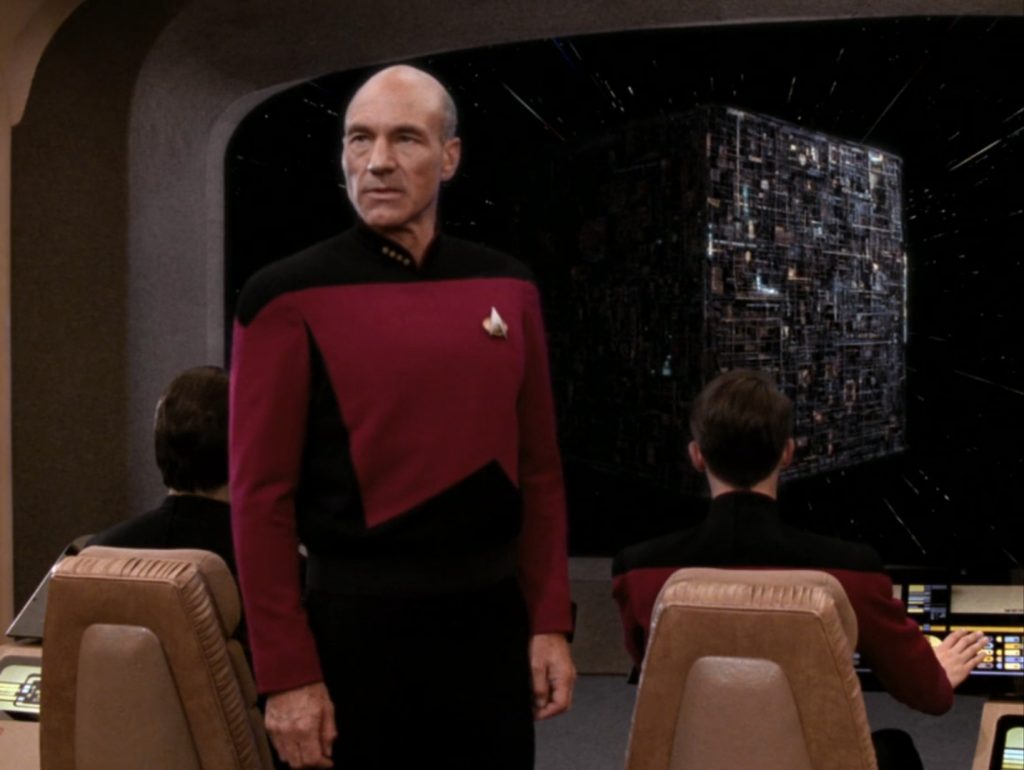
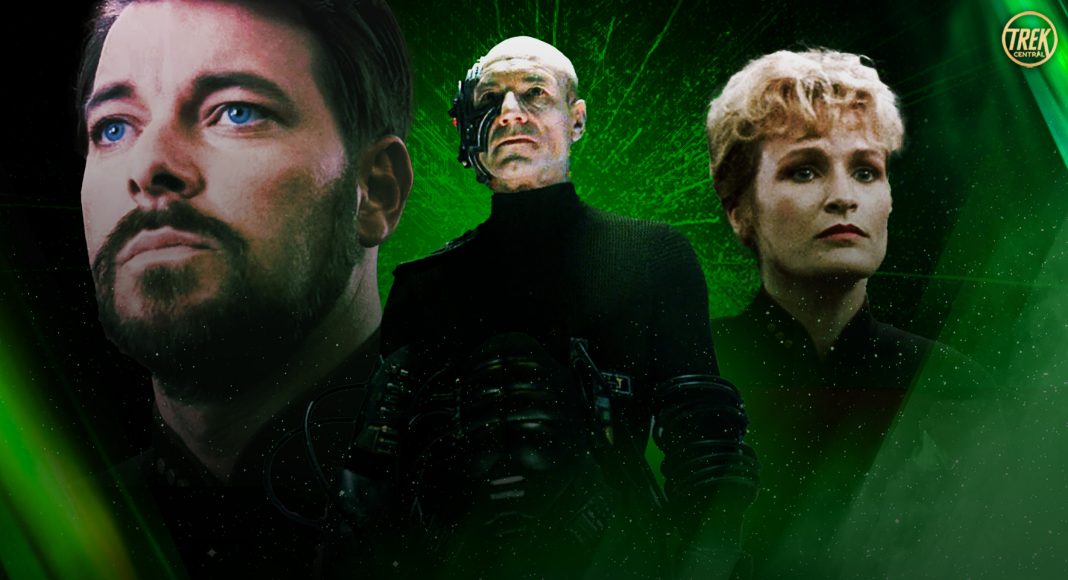
Humanity’s greatest enemy has arrived. The crew of the Enterprise-D encountered them only a year prior. Q (John de Lancie) sent them on a short and deadly trip to the edge of the Delta Quadrant. Now, at the start of ‘The Best of Both Worlds’, the Enterprise discovers evidence that they’ve reached Federation space. Starfleet sends a specialist, Lieutenant Commander Shelby (Elizabeth Dennehy), who confirms everyone’s fears. And Starfleet isn’t ready.
The Enterprise engages in a game of cat and mouse with the single Borg cube. They take refuge in a nebula, providing cover from the Borg and giving them a chance to repair the ship after their initial battle. However, it’s not long before the Borg flush them out and steal their prize – Captain Jean-Luc Picard (Patrick Stewart). They assimilate Picard into their collective, planning to use the newly christened ‘Locutus of Borg’ to attack Earth. Part 1 ends with acting Captain William Riker (Jonathan Frakes) ordering the Enterprise to fire on the cube, with Picard still aboard it.
Part 2 continues the episode with Riker’s attack failing to damage the Borg cube. Now Picard is a part of their collective, the Borg share his knowledge. The cube resumes course for Earth, leaving a crippled Enterprise in its wake. It wipes out Starfleet’s 40-ship armada at Wolf 359 by turning Picard’s expertise to their advantage. The Enterprise manages to reach the cube, capture Locutus, and reverse Picard’s assimilation. They use Picard’s new Borg knowledge to destroy the cube just before it reaches Earth.
Resistance Is Futile
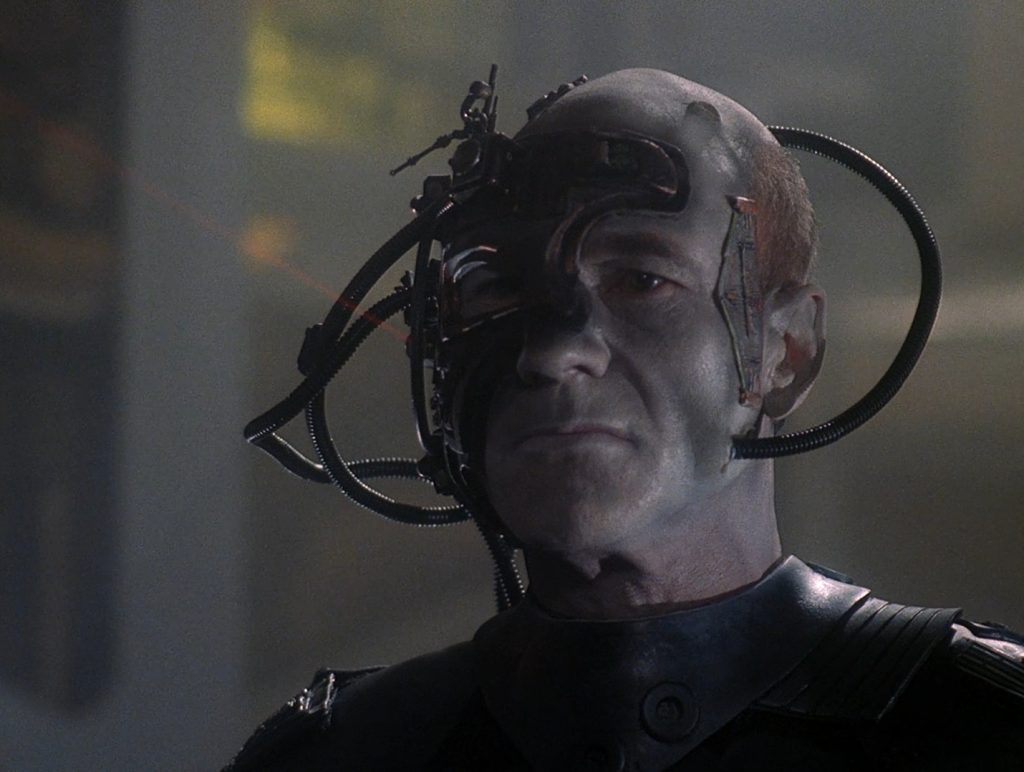
The infamous Borg strapline implants fear into those who hear it. However, what’s scarier is that they almost deliver on this promise in ‘The Best of Both Worlds’.
The Borg quickly overpower the Enterprise, kidnap Picard, and assimilate him into their collective. Picard’s transformation into Locutus is horrific. They take his individuality, his sense of self, and use him and his knowledge to destroy Starfleet’s armada at Wolf 359. Locutus is responsible for the deaths of 11,000 people, a tragedy Picard needs to live with for the rest of his life.
Picard’s assimilation has a devastating effect on his crew as well. They mourn the loss of their captain but are forced to struggle with the fact that he’s not dead. Instead, their former leader and father figure has been turned against them, leading the charge to assimilate Earth. The Borg transformed their inspirational leader into their greatest adversary.
The Pressure Of Command
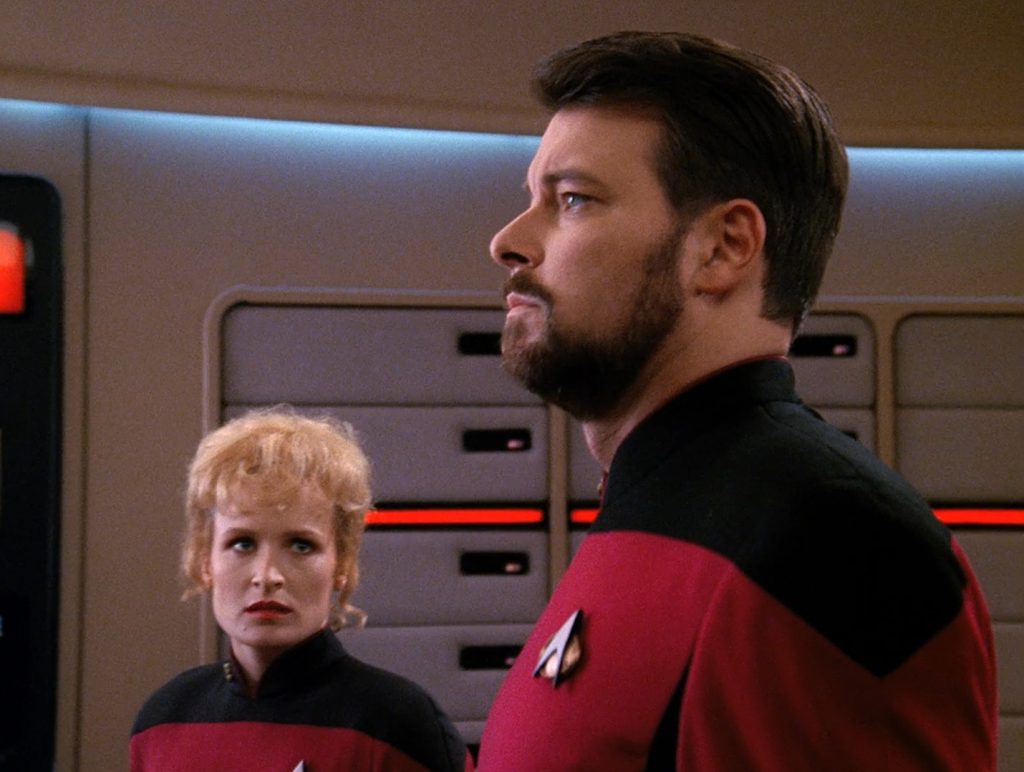
The loss of one Captain means another must step up and assume command. Riker spends the start of Part 1 struggling with a dilemma. He joined the Enterprise as a driven and ambitious first officer, with a clear career path leading to the Captain’s chair. Three years later, Starfleet has offered him a ship several times, only for him to refuse. Riker has become loyal to his Captain, ship, and crew, almost to a fault.
However, this loyalty is now potentially jeopardising his career. He’s been offered another command (the U.S.S. Melbourne) and is tempted to decline again. But there are young, ambitious officers climbing the ranks fast, and it may not be long before Riker is falling behind them. Shelby is a great example – driven, confident, and unafraid to innovate and take risks to succeed. Riker, in contrast, has developed wisdom over the years, learning to consider the crew’s safety and the wider ramifications of his actions.
These differences lead to a natural clash between Riker and Shelby. But Riker (with a nudge from Picard) sees his younger self within her. And after Picard is abducted and Riker assumes command, he knows he needs Shelby by his side as first officer. Their differences complement each other, and together with the rest of the Enterprise crew, they prove resistance is not futile at all.
David & Goliath
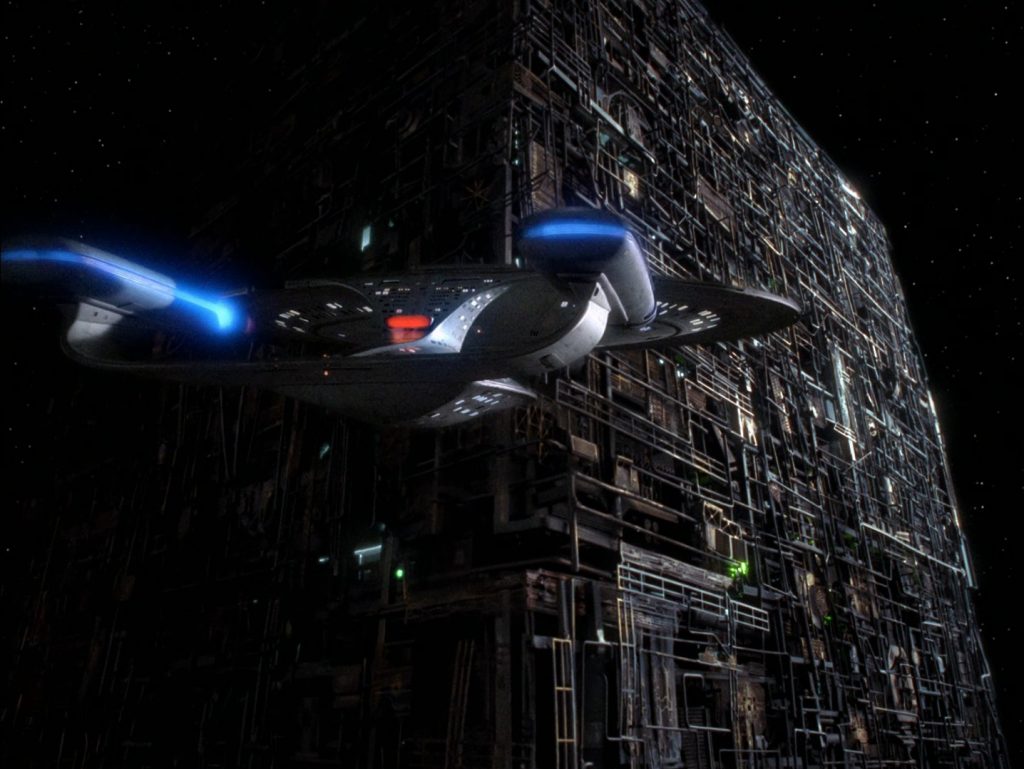
‘The Best of Both Worlds’ is, in some respects, a retelling of ‘David & Goliath’. The Borg represent Goliath, huge and overpowering, with technology far more advanced than the Federation’s. The Enterprise is David, small and (apparently) inconsequential compared to Goliath’s might.
However, what the Enterprise crew lacks in sheer power, they gain back (and more) in ingenuity. They think outside the box, creating new ways to tackle the Borg threat. Sometimes they succeed, like Data’s remodulating phaser fire to break the ship free from the Borg tractor beam. Sometimes they fail, like overclocking the deflector dish at the end of Part 2 in an attempt to disable or destroy the Borg cube. It’s without a doubt humanity’s ability to adapt and improvise that ultimately leads to the Enterprise’s victory.
What this epic battle also succeeds in is establishing the Borg as one of Star Trek’s most notorious villains. They are revisited multiple times in future series and films, including Star Trek: Voyager, Star Trek: Enterprise, and Star Trek: First Contact. Voyager and First Contact are very good at continuing the David & Goliath motif. This maintains the Borg’s threat levels and the Federation’s stakes at their highest.
Forever Changed
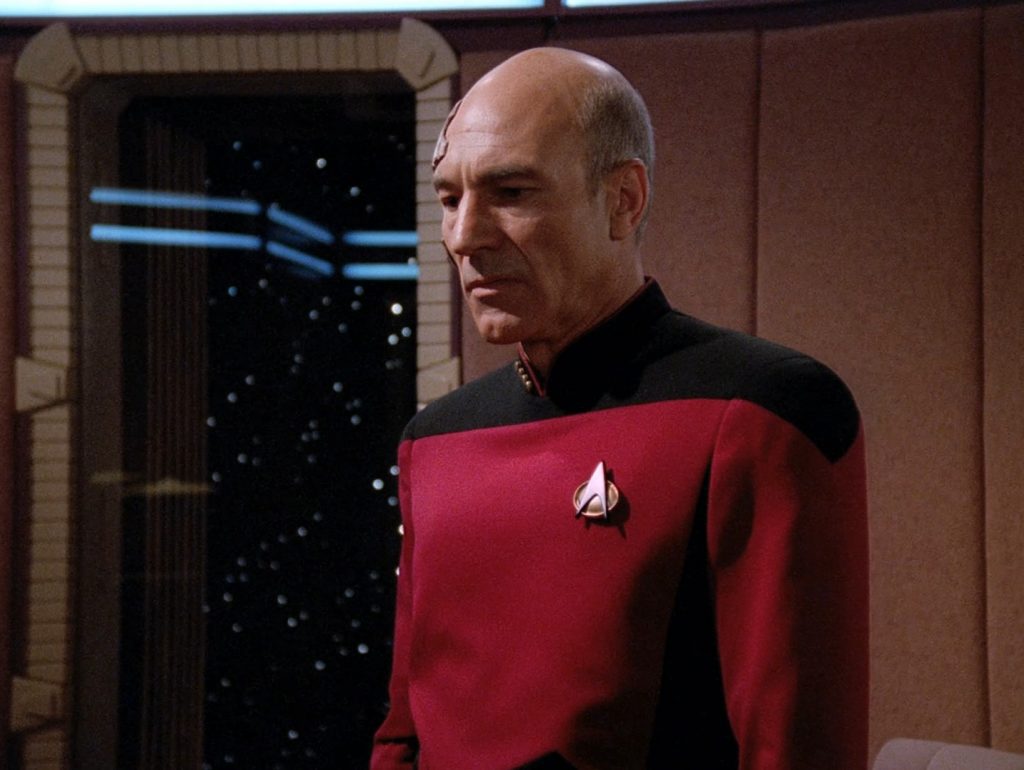
The Borg’s attack throughout ‘The Best of Both Worlds’ has resounding consequences that are felt in future Star Trek series and movies alike. Starfleet is vulnerable and must recover from the loss of 40 ships and 11,000 souls. It pivots its focus to future ships and technology that can better combat the Borg and provide better protection for the Federation.
The events of this episode also have an understandably lasting effect on Picard. His assimilation changed him forever, initially explored in Season 4 Episode 2 ‘Family’ (more on this soon, as it celebrates a similar birthday!). Picard needs to come to terms with the atrocities carried out by Locutus and accept that those actions were not his own. And then there’s his longer-term PTSD, reinforced by his lasting connection to the collective. This is all explored in future episodes, series, and movies, namely Star Trek: First Contact and Star Trek: Picard.
This is one of the many reasons why ‘The Best of Both Worlds’ still resonates so well with the Star Trek fandom 35 years later. The events of the episode establish a powerful enemy. The consequences of these events shape the future of the franchise. And there are lasting consequences for key characters in TNG, which provide compelling future development and stories. I expect that this two-parter will stand the test of time and will still be considered one of TNG’s best episodes for years to come.
More From Trek Central
🔥 – Star Trek Online: Unleashed Launches on PC
📰 – Review – Star Trek: Khan – Episode 3 ‘Do Your Worst’
🔎️ – Review – Fanhome’s Issue #10 – U.S.S. Dauntless
Join the Star Trek conversation via our social media platforms:
- Facebook – https://www.facebook.com/TrekCentral
- Patreon – https://www.patreon.com/TrekCentral
- Instagram – https://instagram.com/TrekCentral
- BlueSky – https://bsky.app/profile/trekcentral.net
- Twitter – https://twitter.com/TheTrekCentral
- YouTube – https://youtube.com/TheTrekCentral
- Mastodon – https://mastodon.social/@[email protected]
- Discord – https://discord.gg/fF2heMbfW8